
What Probate Covers in Clare County
Probate is the court process for handling what a person leaves behind and for protecting people who cannot manage their own affairs. In Clare County that work runs through the Probate and Family Court. The court opens and supervises estates, decides whether a will is valid, and appoints the person who will settle the accounts. It also names guardians and conservators when a child or an adult needs someone to make decisions for them.
The same Clare County court carries a family-division caseload that sits close to probate. That side hears matters like guardianship of minors, certain protective proceedings, and mental health cases. Because these case types share one judge and one clerk counter, Clare County callers often reach the right office even when they are not sure whether they have an estate question or a family question. The table below breaks down the main case types the court handles so you can point your request at the correct Clare County file.
| Case Type | What the Court Handles |
|---|---|
| Decedent estates | Wills, intestate estates, and appointment of a personal representative |
| Guardianship | Guardians for minor children and for incapacitated adults |
| Conservatorship | Management of a protected person's money and property |
| Trusts | Trust administration and disputes brought before the court |
| Mental health | Protective and treatment proceedings that stay largely closed |
| Family division | Adoptions, juvenile matters, and related probate and family work |
Probate Terms Defined
Probate paperwork leans on a handful of words that show up on almost every filing. Reading a case summary is easier once these terms are clear. The short glossary below covers the ones you are most likely to see on a Clare County probate estate or guardianship file.
- Testator
- The person who made the will. When the testator dies, the will is filed with the court so it can be proved and carried out.
- Executor
- The person named in the will to settle the estate. Michigan filings often call this role the personal representative.
- Intestate
- Dying without a valid will. The court then follows state law to decide who inherits and who administers the estate.
- Guardianship
- A court order giving one person authority to make personal and care decisions for a minor or an incapacitated adult.
- Conservatorship
- A court order placing a protected person's money and property under a conservator who manages and reports on it.
How to Search Clare County Probate Records
Michigan runs a statewide public case-search tool called MiCOURT Case Search, and it is the main front door for probate case information. Clare County does not publish a separate local probate portal, so the state system and the clerk counter carry the search. MiCOURT is name-driven, with filters for status and a date range, and it may show civil, criminal, domestic, and probate cases depending on the court. If a file is not online, the fallback is a visit or a written request to the Clare County Probate and Family Court clerk.
A workable search sequence looks like this:
- Open MiCOURT Case Search at micourt.courts.michigan.gov/case-search and choose the case-search option.
- Enter the best identifier you have, usually the full name of the person whose estate or case you need.
- Narrow the results with the status filter or a date range when a common name returns too many matches.
- Submit the search and open the matching result to read the case summary or docket.
- If nothing appears, contact the Probate and Family Court clerk to check for a paper file or a record held only at the counter.
Not every document is online. Michigan court rules keep public case information searchable while limiting which full document images reach the internet, so Clare County wills, inventories, and accountings are often read or copied at the courthouse rather than downloaded.
Clare County Probate and Family Court Contact
One court handles probate and family matters for Clare County, and it shares the Harrison courthouse with the circuit and district courts. Hon. Marcy A. Klaus serves as the Clare County Probate and Family Court judge for both Clare and Gladwin Counties. Calls about estates, guardianships, or copies of a Clare County probate file go to the office below.
Clare County Probate and Family Court
225 W. Main Street
Harrison, MI 48625
(989) 539-7109
Fax: (989) 539-7229
Judge: Hon. Marcy A. Klaus
Hours: Monday to Friday, 8:00 am to 4:30 pm
Because the office sits at the same address as the other courts, mail and walk-in traffic can be busy. Calling ahead confirms whether a file is on-site, whether it is old enough to be in storage, and what a copy of a specific document will cost.
Access Limits on Clare County Probate Records
Clare County probate files are public by default, but several categories carry real limits. Court rules let a judge restrict access by order, and state law closes certain case types outright. Juvenile records are the clearest example. They are not open public files, and access is controlled by statute rather than by a simple counter request.
The rules that shield juvenile files are set out in state law. You can read the access limits directly at MCL 712A.28 on juvenile record access, which frames how these records are kept and who may see them. The screenshot below shows that statute page.
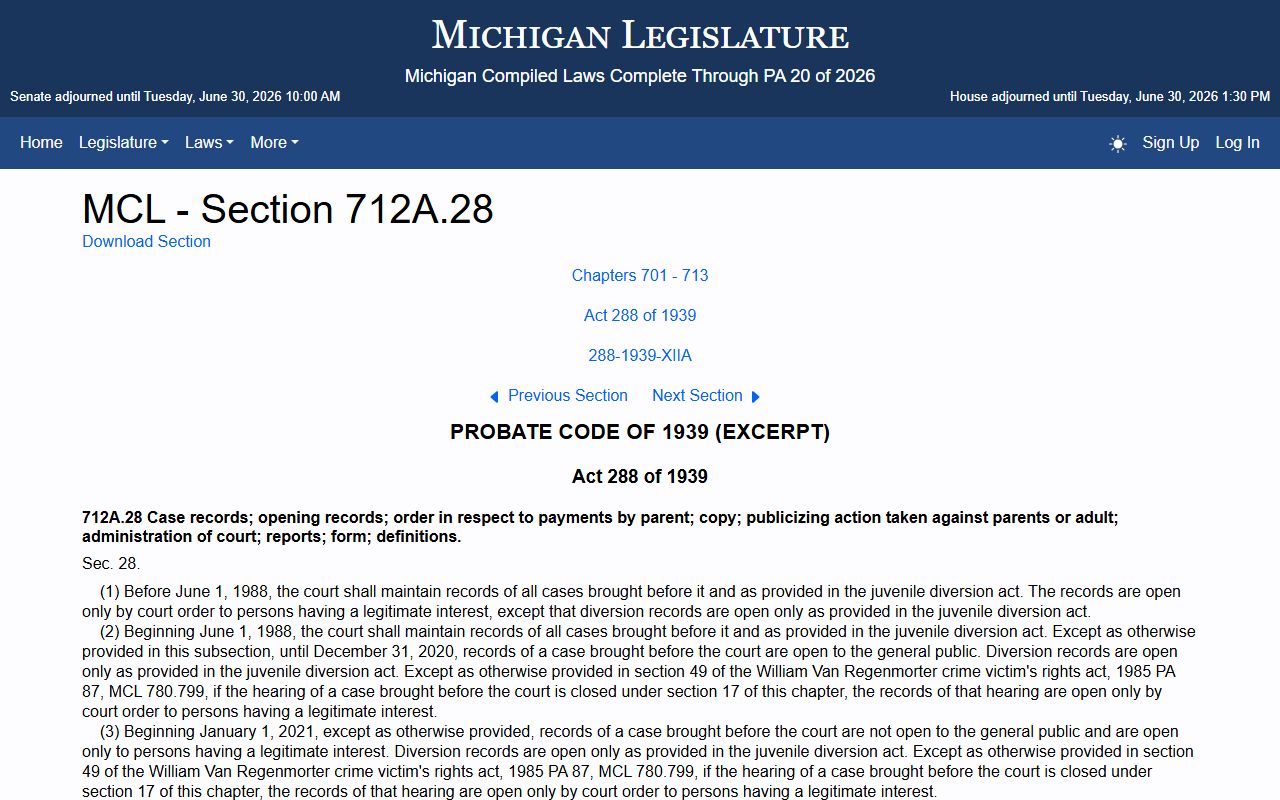
That distinction matters on the probate and family side, where juvenile and guardianship-of-minor cases can travel together. Mental health proceedings are also generally closed or limited, and personal data like Social Security numbers and financial account numbers is redacted or kept nonpublic across court files.
Important: A sealed, juvenile, or mental health file will not surface in a public search, so a blank MiCOURT result does not always mean no case exists.
What Clare County Probate Records Show
An open Clare County estate file builds a paper trail from the first application to the final distribution. Most probate records hold a mix of the documents that prove the will, list the property, and account for how the estate was handled. A typical decedent estate file can include:
- The petition or application that opened the case
- The will, if one exists, plus any codicils
- The order appointing the personal representative
- An inventory of the estate's assets
- Annual or final accountings of money paid out
- Orders closing the estate and approving distribution
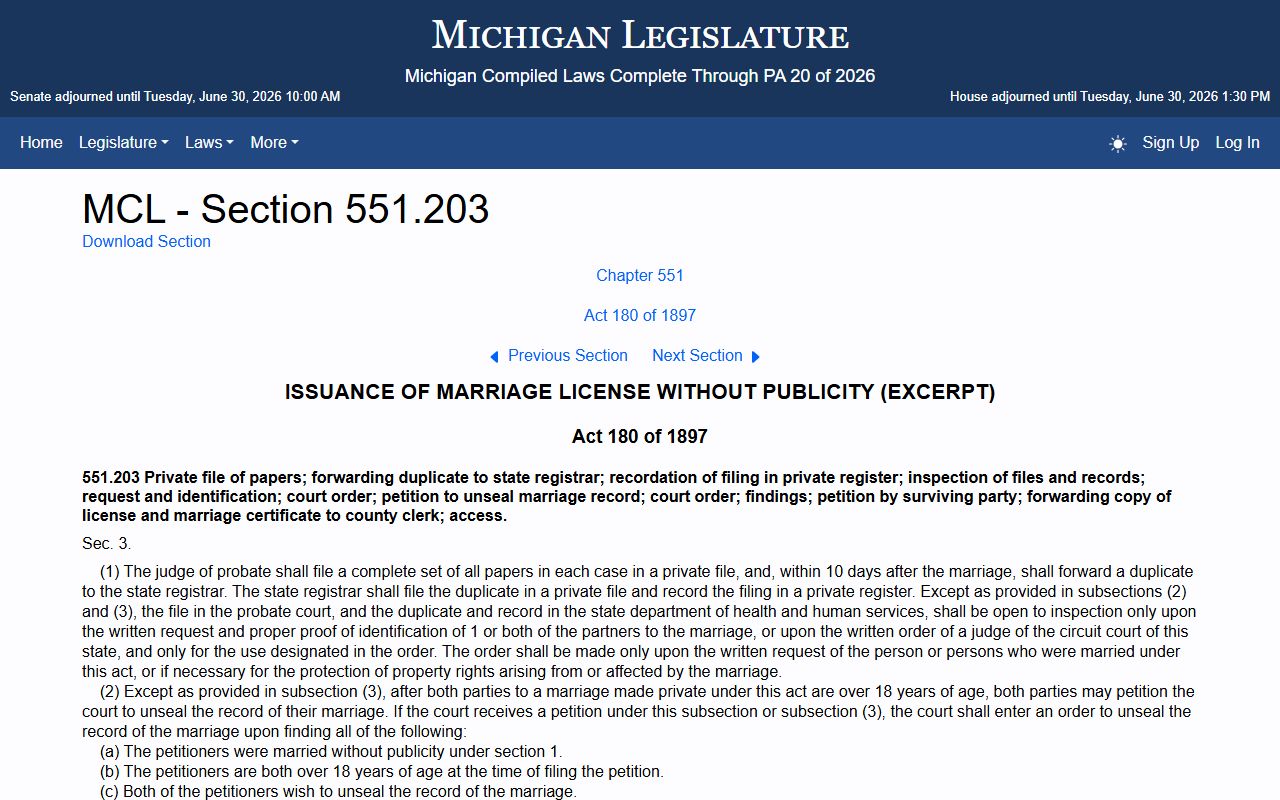
Some records that touch estates carry their own privacy rules. A no-publicity marriage license, for example, is inspected only under narrow conditions set by state law, which can matter when a marriage must be proved to settle who inherits. The rule appears at MCL 551.203 on private marriage record inspection, pictured below.
Guardianship and conservatorship files follow a similar shape, with a petition, an order, and reports the guardian or conservator files over time. Reading the order first tells you what powers the court granted before you dig through the rest of the record.
Certified Copies and Vital Records Overlap
Settling a Clare County estate usually means gathering certified vital records alongside the court file. A death record proves the person died, and marriage records can decide who inherits. Those certificates are not probate documents. They come from the Michigan Department of Health and Human Services or the County Clerk, not the Probate and Family Court, so plan for two separate requests when a matter reaches the probate stage.
State turnaround times help you time those requests. The MDHHS vital records turnaround page lists how long certified copies take to arrive.
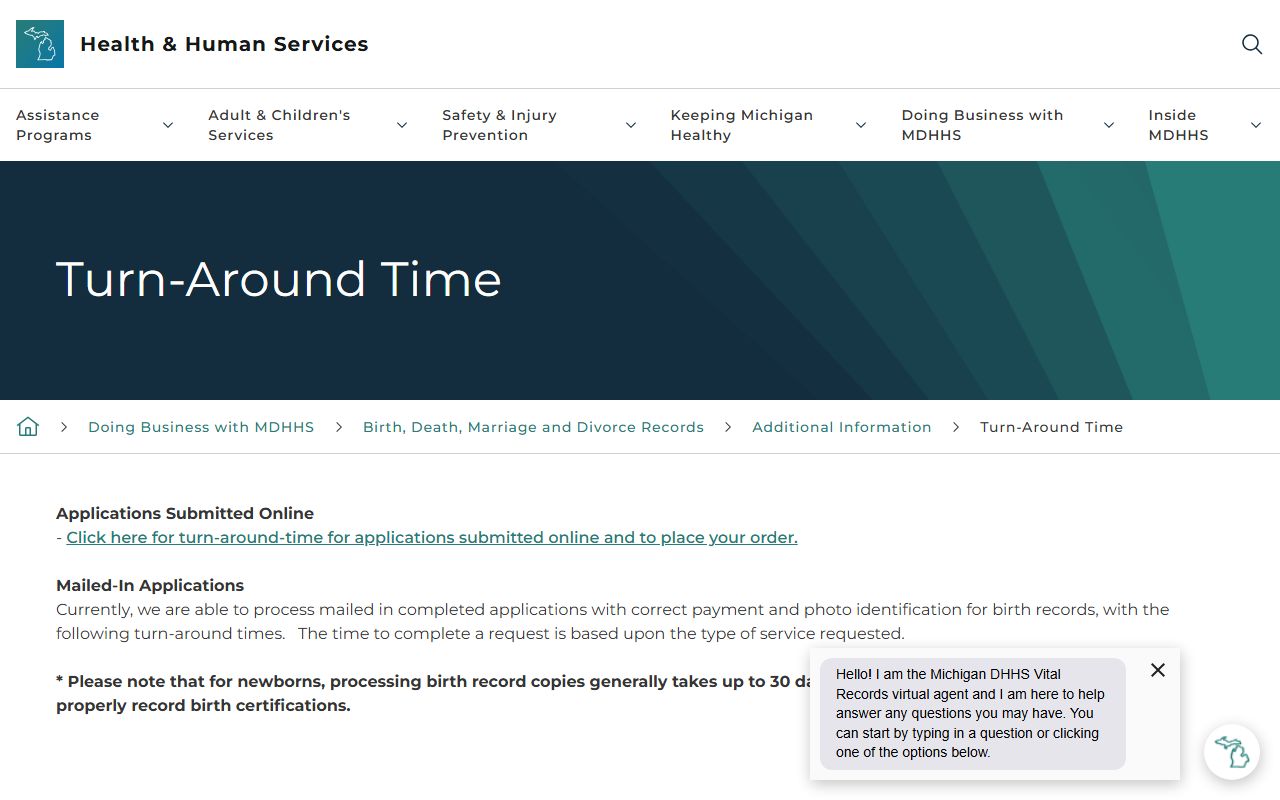
The image confirms the standard windows: roughly four to five weeks for regular service and two to three weeks for expedited handling. Divorce records that affect an estate follow the same split, with the court judgment held at the circuit court and the certified certificate ordered through the state. The table sums up where each certificate comes from.
| Certificate | Where the Certified Copy Comes From | Typical Turnaround |
|---|---|---|
| Death record | MDHHS Vital Records | 4 to 5 weeks regular, 2 to 3 weeks expedited |
| Marriage certificate | MDHHS Vital Records or the County Clerk | 4 to 5 weeks regular, 2 to 3 weeks expedited |
| Divorce record | MDHHS Vital Records; court file at Circuit Court | 4 to 5 weeks regular, 2 to 3 weeks expedited |
For the marriage and divorce side of an estate, the Clare County marriage and divorce records page walks through the license and certificate steps in more detail.
When a Clare County Probate File Is Older or Offline
Older Clare County estates and closed guardianships often live only on paper. MiCOURT leans toward more recent case information, so a decades-old estate may not appear in a name search at all. That absence is normal and does not mean the file is gone. It usually means the record sits in the courthouse or in storage rather than in the public search index.
The reliable path for an older or offline file is a direct request to the Clare County Probate and Family Court clerk. Call the office first to confirm the file exists and to learn how it is stored. Ask what a certified copy of a specific document costs, since the county did not publish a standing probate fee schedule, and confirm current fees with the court before you send a check. Certified copies of court records carry legal weight, and the authority for issuing certified vital-record copies is set out at MCL 333.2882 on certified-copy authority, shown below.
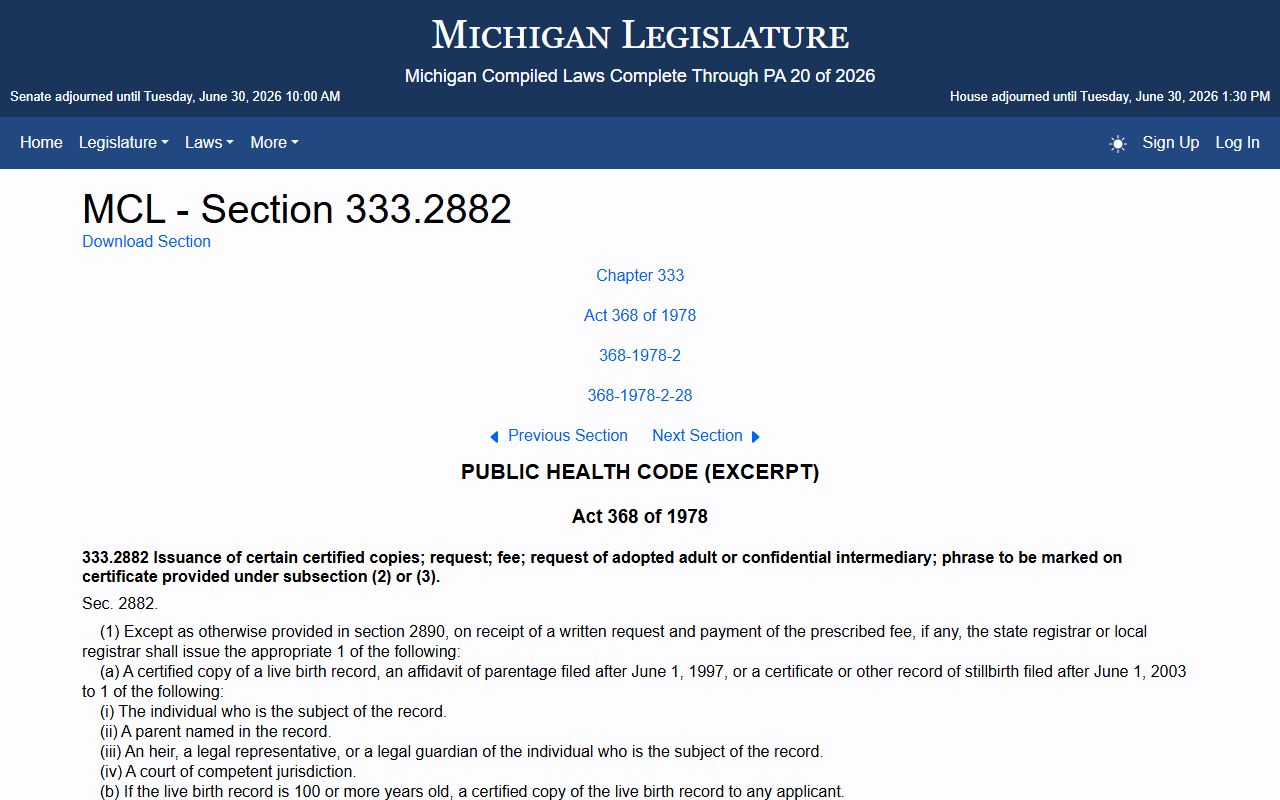
That statute governs certified copies on the vital-record side, and the probate clerk applies the parallel court-record rules for estate and guardianship documents. When a file is neither online nor at the counter, a written request lets the clerk pull it from storage. Bring or list the full name, an approximate date, and a case number if you have one, because a precise identifier is what turns a slow search into a quick pull.
Tip: Confirm the exact document, the number of certified copies, and the current fee with the Probate and Family Court before mailing any payment.