
Criminal Court Records in Clare County
A criminal court record is the case file the court clerk opens the moment a criminal charge is filed. It is not the arrest paperwork and it is not a jail log. It is the running account of the court case itself: the charging document, every hearing, each order the judge signs, the plea or verdict, and the sentence at the end. The clerk of court holds and updates this file as the case moves forward, and it stays part of the public court record after the case closes unless a statute, court rule, or judge's order restricts it.
Two trial courts in Clare County produce these records, and both sit inside the county courthouse in Harrison. The 55th Circuit Court handles felony cases, which are the most serious crimes and can carry prison time. The 80th District Court handles misdemeanors, lower criminal matters, and the early stages of felonies, including the preliminary examination that decides whether a felony moves up to circuit court. Because the two courts share one building and one clerk's counter, a single case can leave records in both places as it climbs from a first appearance to a felony trial.
How to Search Clare County Criminal Court Records
Michigan does not run a separate Clare County case website. The statewide front door is MiCOURT Case Search, which pulls civil, criminal, traffic, domestic, and probate cases from participating courts into one name-driven search. It is the fastest way to confirm a case exists and to open the docket. When a case or an older file is not online, the fallback is the clerk's counter at the courthouse or a written records request.
- Open the MiCOURT Case Search portal on the Michigan Courts website.
- Enter the defendant's name, since the search is built around a name lookup rather than a case number.
- Narrow the results with the status filter and the From and To date fields when a common name returns too many matches.
- Open the matching case to read the docket entries, hearing dates, and the disposition line.
- Request a certified copy from the Clare County Clerk at the courthouse when you need a court-stamped document.
For a statewide criminal history rather than a single case, Michigan State Police runs the Internet Criminal History Access Tool, known as ICHAT. A helpful reference for how the state organizes its criminal history services is the Michigan State Police criminal history records page.
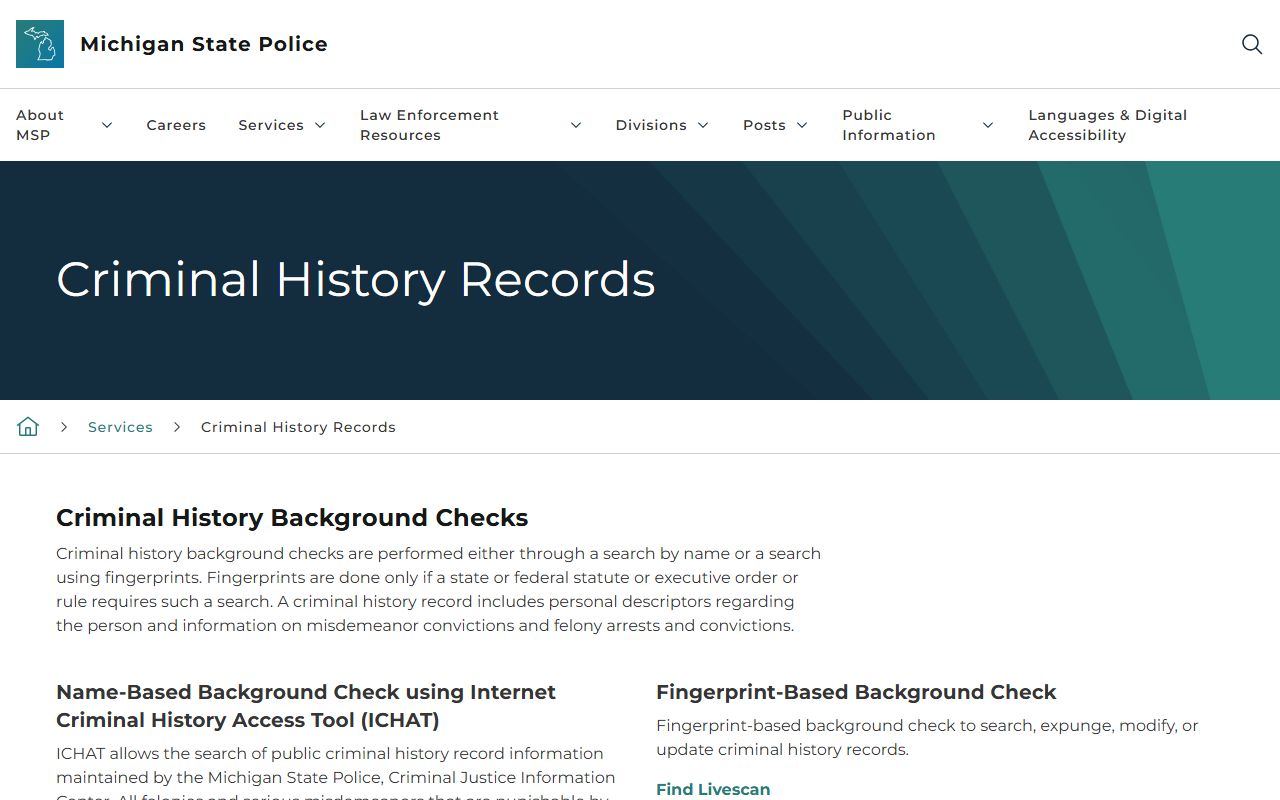
ICHAT returns Michigan felony and misdemeanor convictions statewide, but it is not a complete criminal court file. It leaves out warrants, juvenile records, traffic records, most local ordinance offenses, and out-of-state records, so a clean ICHAT result does not mean a person has no case in the Clare County courts. For the actual charges as filed in a specific case, the Clare County court charge records page follows the charging side of the file more closely.
Stages of a Clare County Criminal Case
A criminal case moves through a set of fixed steps, and each step drops an entry into the court record. Reading the file in order is the clearest way to see where a case stands. In Clare County a felony often starts in district court for the early appearances, then transfers to circuit court for trial and sentencing, while a misdemeanor stays in district court from start to finish.
Case flow: Charges Filed › Arraignment › Pretrial / Motions › Plea or Trial › Disposition › Sentencing
| Stage | What Happens |
|---|---|
| Arraignment | The defendant hears the charges for the first time, is told their rights, and enters an initial plea. Bond and release conditions are usually set here. |
| Pretrial / Motions | Both sides exchange information, the judge rules on motions, and many cases resolve through a negotiated plea before trial. |
| Plea or Trial | The defendant pleads guilty or no contest, or the case goes to a jury or bench trial that ends in a verdict. |
| Sentencing | After a plea or a guilty verdict, the judge imposes the sentence, which can include jail, prison, probation, fines, or treatment. |
What a Clare County Criminal Court Record Shows
Michigan court records follow the format set by the court rules, not by any single county, so a Clare County criminal file carries the same core fields you would find across the state. The docket lists filings and hearings in date order, and the case summary pulls the key facts to the top. The table below breaks down the fields that matter most when you read a criminal case.
| Field | What It Shows |
|---|---|
| Case Number | The unique court file number, which also signals the court level and case type. |
| Defendant | The person charged, with the party listing and attorney of record. |
| Charges | Each count as filed, with the statute cited and the severity level, from misdemeanor to felony. |
| Plea | The response entered to each count: guilty, not guilty, or no contest. |
| Disposition | How each count ended: convicted, dismissed, acquitted, or otherwise resolved. |
| Sentence | The penalty imposed after conviction, including jail, probation, fines, and conditions. |
The file also carries the filing date, the judge or magistrate assigned, docket entries for each motion and order, and financial fields for fines and costs. Some data is protected. Under the court rules, personal identifiers such as Social Security and financial account numbers are redacted or kept nonpublic, so a public search can confirm the case without exposing that information.
Reading Dispositions and Sentences
The disposition line is the heart of a criminal record because it tells you how the case actually ended. A single case can hold several dispositions when a defendant faces more than one count. A sentence appears only after a conviction, and it spells out the penalty in plain terms once the judge signs the judgment.
- Arraignment
- The first court appearance on the charges, where the defendant is advised of the charges and enters an initial plea.
- Plea
- The defendant's formal answer to a charge: guilty, not guilty, or no contest, which admits the penalty without admitting guilt.
- Disposition
- The outcome of a count, such as a conviction, a dismissal, or an acquittal.
- Deferred
- A path where a plea is held back and the case can be dismissed after conditions are met, common in some drug and youthful-offender cases.
- Sentence
- The punishment ordered after conviction, which can mix jail, probation, fines, and treatment.
- Probation
- A supervised alternative to jail that lets a person stay in the community under court conditions.
Charges vs. Convictions in Clare County Criminal Cases
Being charged is not the same as being convicted, and a criminal court record keeps both apart on purpose. In Clare County, the elected prosecuting attorney, Andrew J. Santini, reviews cases and decides what charges to file. A charge is only an accusation. It can be amended, reduced, dropped, dismissed, or end in an acquittal, and the record still shows it. A conviction is the finding of guilt that follows a plea or a guilty verdict.
| Charge | Conviction | |
|---|---|---|
| Stage | Accusation | Verdict or plea |
| Burden of Proof | Probable cause | Beyond a reasonable doubt |
| Who Decides | The prosecutor | The judge or jury |
| Public Record | Yes | Yes |
This gap matters when you read an older file. A record can list a serious charge at the top and a dismissal at the bottom, which means no conviction ever attached. Always read the disposition on each count before treating a charge as a conviction.
Background Checks and Clare County Criminal Records
A casual case lookup and a formal background check are not the same thing. When a conviction record is used for employment, housing, or licensing, the search usually runs through a regulated fingerprint-based process rather than a quick name search. Michigan State Police explains how to run, correct, and update a criminal history on its criminal history search and update page.
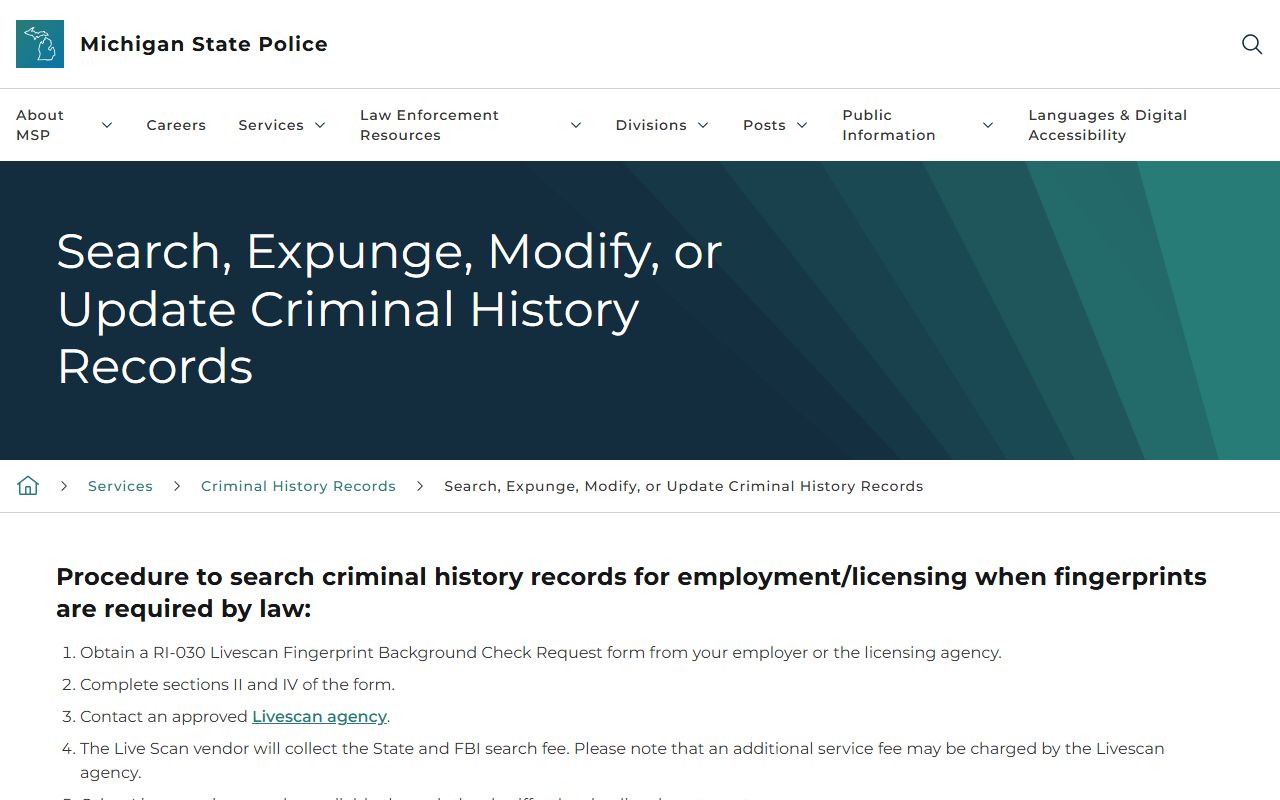
A fingerprint-based check is more reliable than a name check because it ties records to the person rather than to a common name. The Clare County Sheriff's Office runs a live-scan fingerprint machine on weekdays for people who need prints for a licensing or employment check, and callers should confirm fees before they arrive. A name-only search can miss records or pull the wrong person, which is why regulated checks lean on prints.
Important: This website is a private resource and is not a consumer reporting agency under the Fair Credit Reporting Act, so its results cannot be used for FCRA-regulated screening decisions.
Michigan Set-Aside and Clean Slate
Michigan lets many people clear a conviction from the public record through a legal step called a set-aside, which is the state's word for expungement. There are two paths. The application-based path requires filing a petition and waiting out a set period after sentencing, and the automatic path clears eligible convictions on its own without any application. The state keeps a plain overview of both on its conviction set-aside public information page.
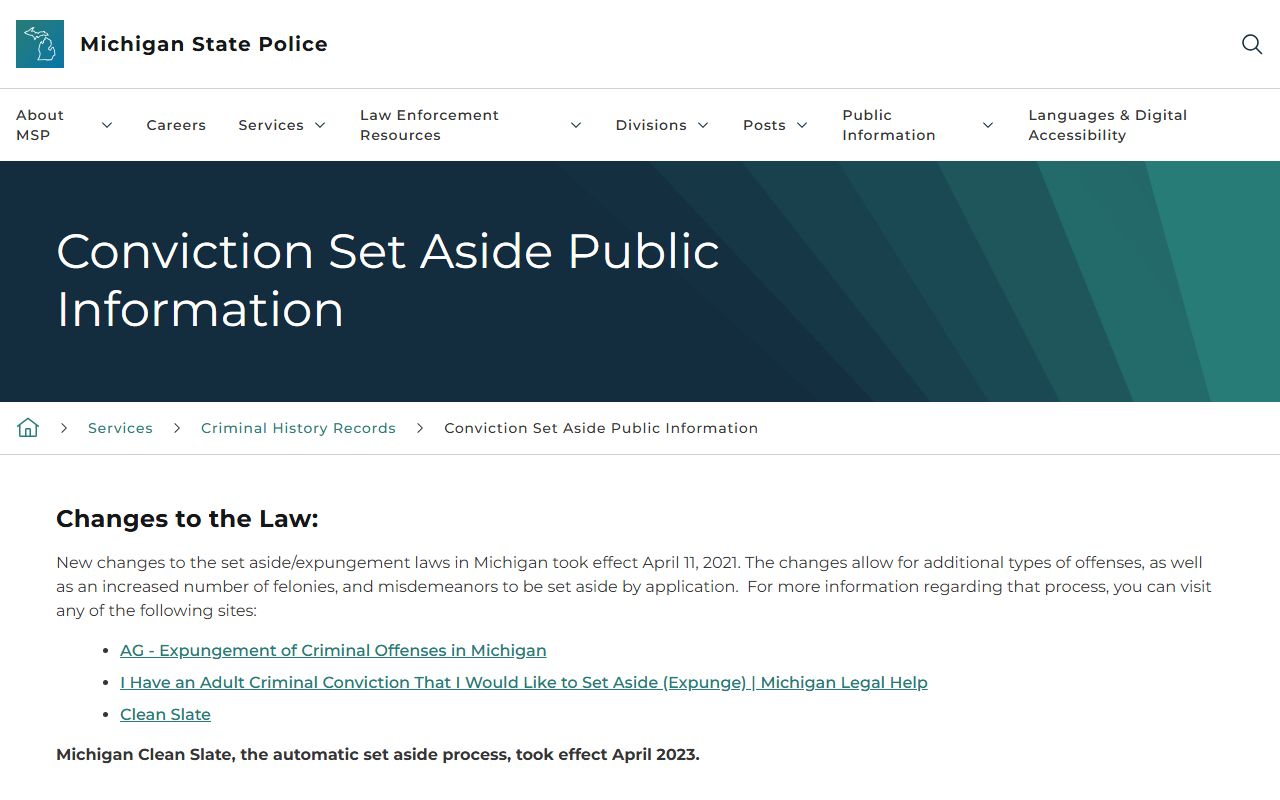
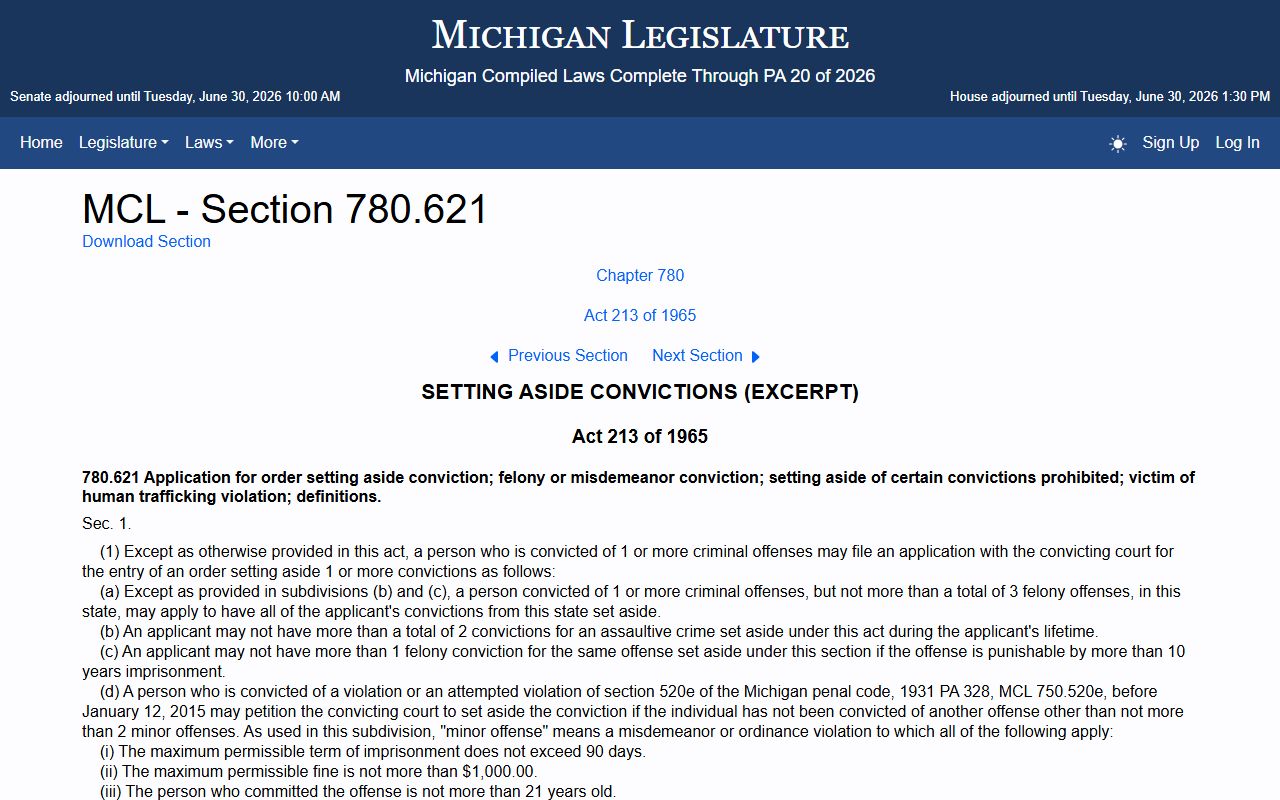
The application path is governed by MCL 780.621, and the waiting periods for felonies and serious misdemeanors are set in MCL 780.621d, measured from sentencing or from the end of any jail, prison, probation, or parole. The automatic path, added under MCL 780.621g, is the heart of the Clean Slate program. Michigan's Clean Slate overview lays out how the automatic system works.
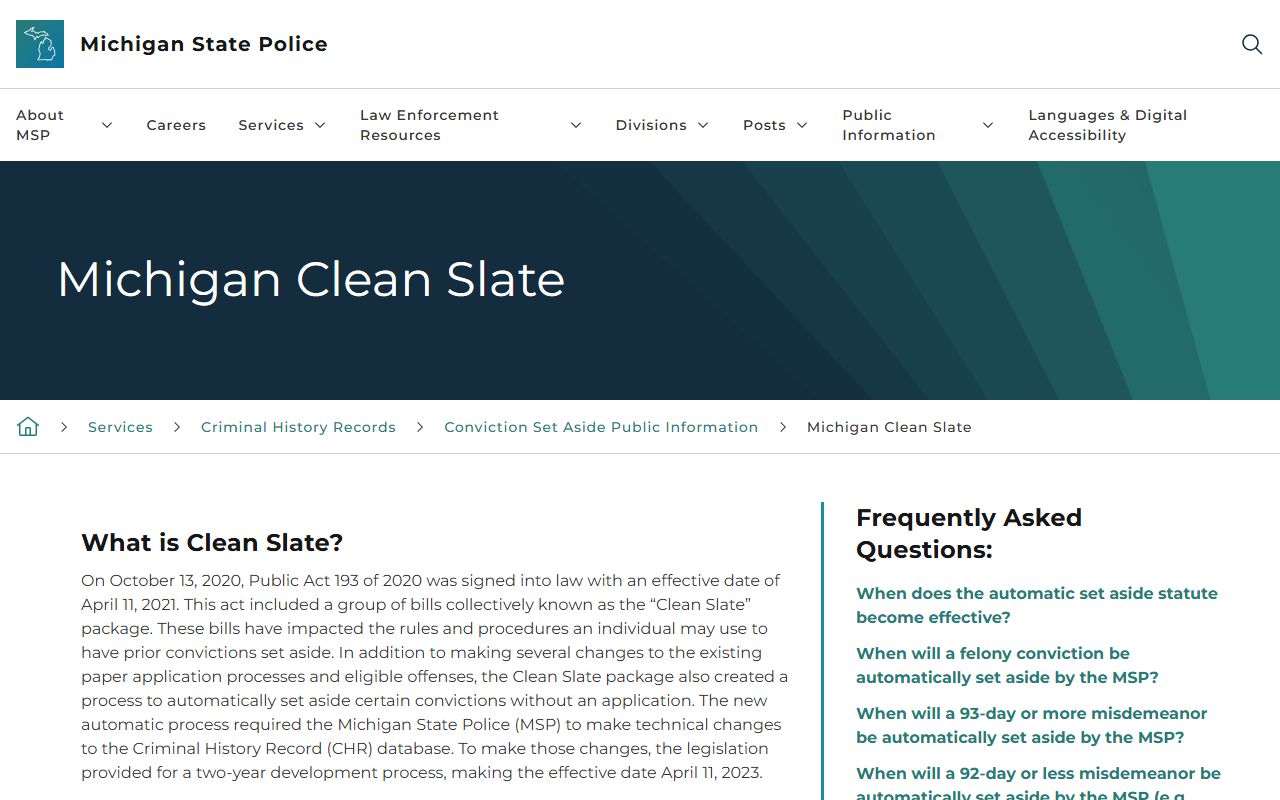
Not every offense qualifies. The state publishes an eligibility guide that lists which convictions the automatic process reaches and which it excludes, such as serious violent and assaultive offenses.
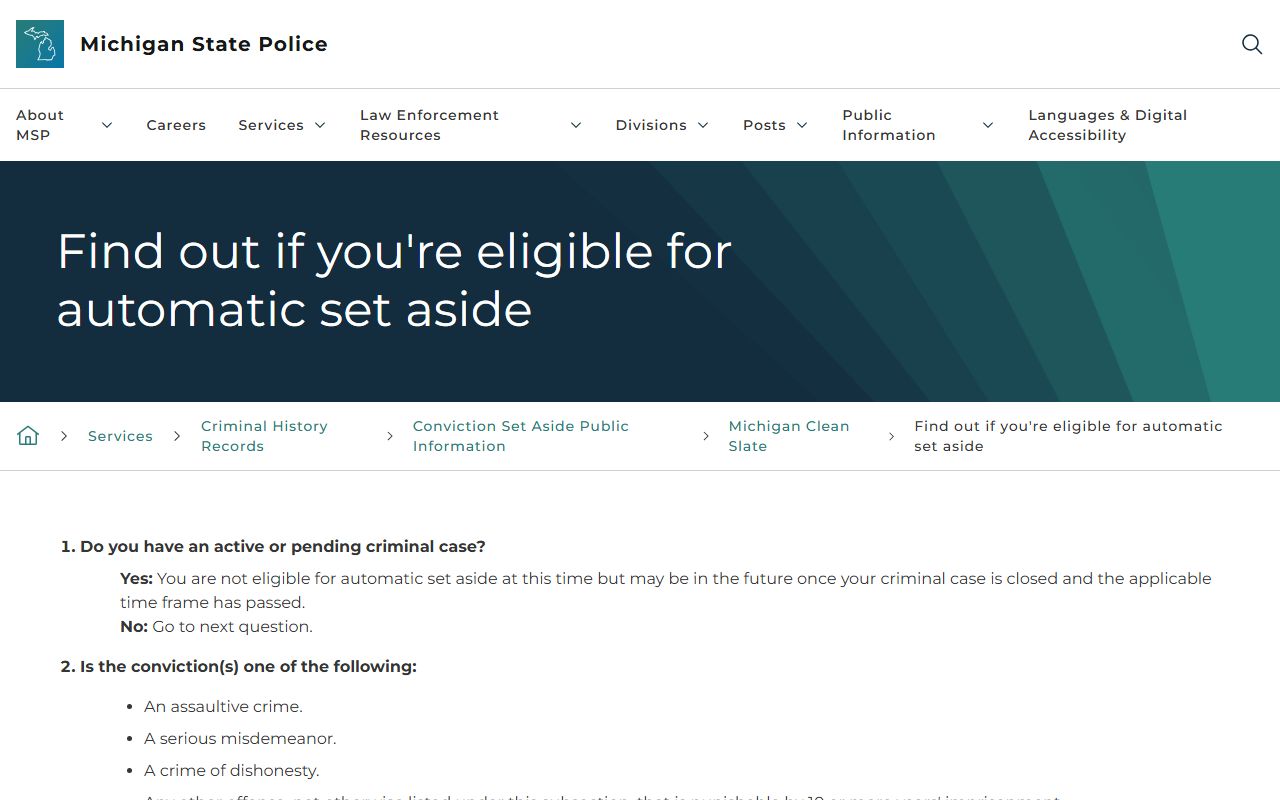
An active or pending case blocks automatic relief until it resolves, so the program works only for people whose eligible cases are fully closed. The full text of the set-aside statute is posted on the Michigan Legislature website for readers who want the exact language.
A set-aside changes what the public can see, but the process is not instant across every system. When a conviction is set aside, public search tools stop returning it, though limited law enforcement and court copies remain for narrow uses the statute allows.
Sealed vs. Expunged Criminal Records
People often use sealed and expunged as if they mean the same thing, but they work differently. A sealed record still exists and is simply hidden from ordinary public search, while an expunged or set-aside record is treated as though the conviction was cleared. The table lays out the split.
| Sealed | Expunged / Set Aside | |
|---|---|---|
| Visibility | Hidden from public search | Cleared from the public record |
| Law Enforcement | Limited access remains | Very limited access remains |
| Eligibility | By statute or court order | MCL 780.621 application or automatic under MCL 780.621g |
Even after relief, some traces can linger in internal state systems, and dismissed arrest entries follow their own removal path under MCL 764.26a. The safe reading is that a set-aside removes a conviction from public view without wiping every record everywhere at once.
Public Access to Clare County Criminal Court Records
Michigan law starts from the position that court records are open. Criminal case files are public unless a statute, a court rule, or a judge's order restricts them, and the court rules control what can be seen, copied, or sealed. For county-held records outside the court file, such as sheriff reports, the Freedom of Information Act is the fallback route. A broader look at every court record type sits on the Clare County court records page.
Key Statutes:
Michigan Court Rule 8.119 - makes court records open to the public unless restricted by law, rule, or order.
Michigan Court Rule 1.109 - defines court records and requires protected personal information to be kept nonpublic.
MCL 15.231 - the Michigan FOIA policy that people are entitled to full information about public records, subject to the act's exceptions.
Restricted Criminal Court Records in Clare County
Some criminal records are held back from public search no matter how open the rest of the system is. Juvenile cases are the clearest example. Access to juvenile records is limited by MCL 712A.28, and most are available only by court order. Set-aside and expunged convictions drop out of public view, and cases still under a protective order or an ongoing investigation may be shielded until they resolve.
Beyond full cases, the court rules keep certain data nonpublic even within an open file. The following categories are commonly restricted:
- Juvenile delinquency and family-division youth cases.
- Sealed and set-aside convictions removed from public search.
- Personal identifiers such as Social Security and account numbers.
- Mental health proceedings, which are generally closed.
- Records under a specific judge's protective order.
When a search stops at a summary line, that limit is usually the court rules at work rather than a missing record. A person can often confirm a case exists while the PII rules and sealing rules still govern what can be inspected or copied.
Note: A criminal court file is a snapshot in time, so always check the latest docket at the courthouse before relying on a status that could have changed after the last public update.