
Clare County Arrest Records and Court Charges
A Clare County arrest record is the record of the arrest itself. It captures who was taken into custody, which agency made the arrest, and the booking that follows at the county jail. The Clare County Sheriff's Office, led by Sheriff John S. Wilson, runs that jail and handles the custody side. The county does not publish a public inmate roster or a mugshot database in the sources reviewed, so the booking detail is not something you look up on an open portal here.
The court charges after an arrest are a separate record. After the police forward their report, the Clare County Prosecutor decides which formal charges to file with the court. Those charges, and every change to them, become the Clare County charge record that follows the case. For the custody and booking side, the county's jail and inmate records page explains the fallback channels. For the full case file, pleas, and sentence, the criminal court records page carries the outcome.
How to Find Clare County Arrest Records and Charges
The Clare County charges filed after an arrest show up in the court case file, not on a sheriff's website. Michigan does not run a separate Clare County court portal, so the statewide MiCOURT Case Search is the front door. It is name driven, with status and date filters, and it covers district, circuit, and probate matters where a court has published them online.
- Open MiCOURT Case Search and choose the case type or court level you need.
- Search by the defendant's name, or enter a case number if you already have one.
- Open the matching case and read the charge list attached to it.
- Check each charge for its statute code, severity level, and current status.
Some Clare County records are not online. Older files, sealed matters, and full document images often require a trip to the clerk's counter at the Harrison courthouse or a formal request. The arrest or booking report itself is a Clare County sheriff record, obtained through a written FOIA request. Copy charges for those records follow Michigan's FOIA copy-fee statute (MCL 15.234).
The fee statute keeps records costs predictable across county offices. The Michigan Legislature publishes the exact language readers can review before they submit a request.
Copies of an arrest report from the sheriff are priced under this same rule. Reviewing the FOIA fee provision before you file makes it easier to know what a certified or plain copy should cost.
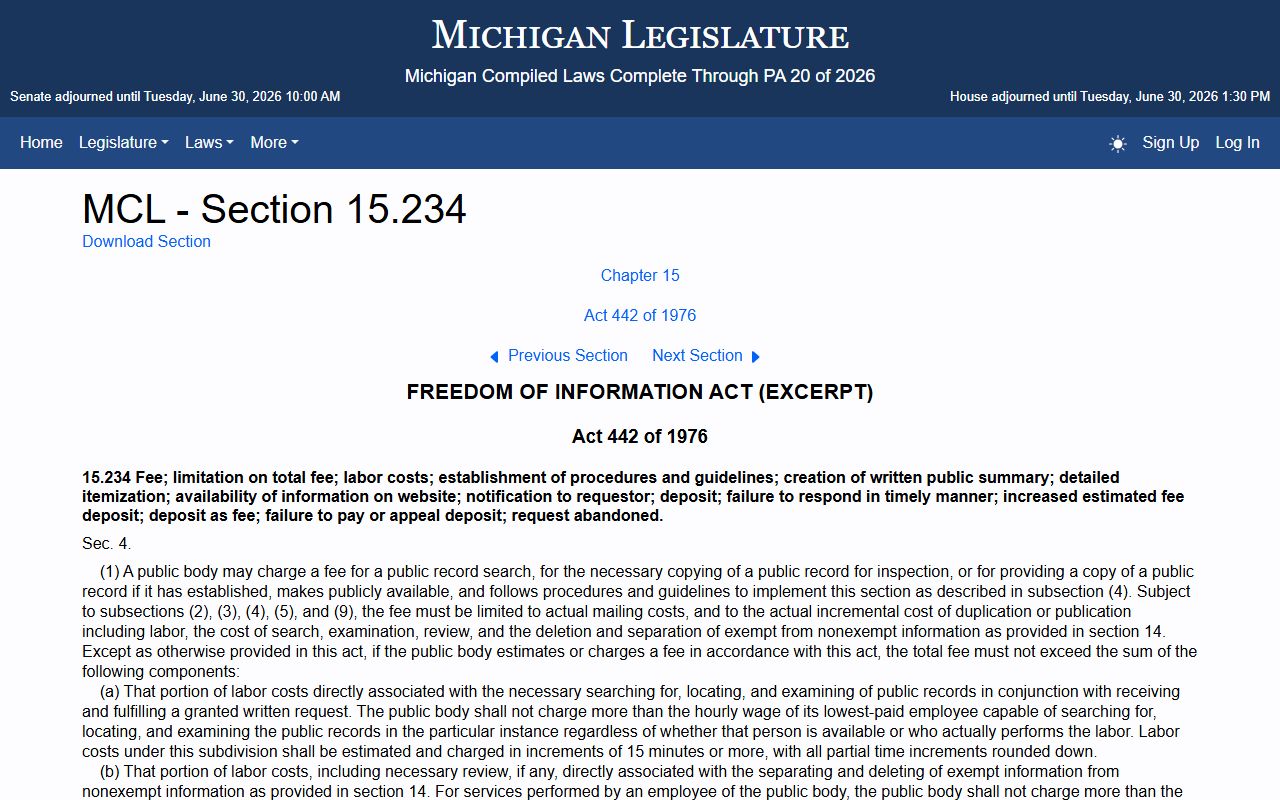
Knowing the fee ceiling up front helps a reader budget a records request and avoid surprises at the counter.
How Charges Get Filed After an Arrest: Complaint, Information, and Indictment
The Clare County charge record begins after booking, when the prosecutor files a charging document with the court. That paper names the accused, lists each offense, and cites the statute the charge rests on. Michigan uses three main charging documents, and the one that applies depends on how serious the offense is.
Most Clare County misdemeanors and the early stage of a felony start with a complaint. Felonies that survive a preliminary examination move forward on an information filed by the prosecutor. A grand jury indictment is rare in Michigan practice but still possible for serious felonies.
| Complaint | Information | Indictment | |
|---|---|---|---|
| Filed By | Officer / Prosecutor | Prosecutor | Grand Jury |
| Common For | Misdemeanors | Many felonies | Serious felonies |
| Starts | The case | The case | The case |
Note: A charge listed on a complaint can look different by the time an information is filed, because the prosecutor can add, drop, or reshape counts as the case develops.
Who Files Charges After a Clare County Arrest
In Clare County, police and the sheriff make the arrest, then forward their reports for review. The decision to charge, and what to charge, belongs to the Clare County Prosecutor, Andrew J. Santini. His office reviews the evidence, weighs whether the proof supports each count, and files the charges that open the court case. The arresting agency does not set the final charges; the prosecutor does.
That split matters for anyone reading a Clare County case. A booking sheet might list one offense while the filed charges read differently, because the prosecutor evaluated the file independently. County agenda materials confirm the office handles warrant and case review as part of that charging role.
Federal crimes follow a different track entirely. When conduct in Clare County becomes a federal matter, charges come from the U.S. Attorney's Office for the Eastern District of Michigan, not the county prosecutor.
Because federal cases skip the county courthouse, a Clare County court search will not surface them, and readers have to check the federal system instead.
Clare County Charge Status and What It Means
Clare County charges rarely stay frozen. As a case moves, the prosecutor can amend a count, reduce it to a lower level, add a new count, or drop it. The court can dismiss a charge outright. The status label attached to each charge in the case file tells you where that specific count stands right now.
| Status | What It Means |
|---|---|
| Pending | The charge is filed and active; no plea or verdict has been entered yet. |
| Amended | The prosecutor changed the charge by filing a revised document. |
| Reduced | The charge was lowered to a less serious offense, often by agreement. |
| Dropped | The charge was withdrawn and is no longer being pursued. |
| Dismissed | The court ended the charge, closing it without a conviction. |
| Nolle Prosequi | The prosecutor formally declined to pursue the charge. |
Some drug cases take a special path. Under Michigan's deferred-proceedings statute, a first-time offender can be placed on probation without a conviction entered, and the charge can be dismissed on successful completion. The full text sits in the deferred drug-case statute (MCL 333.7411).
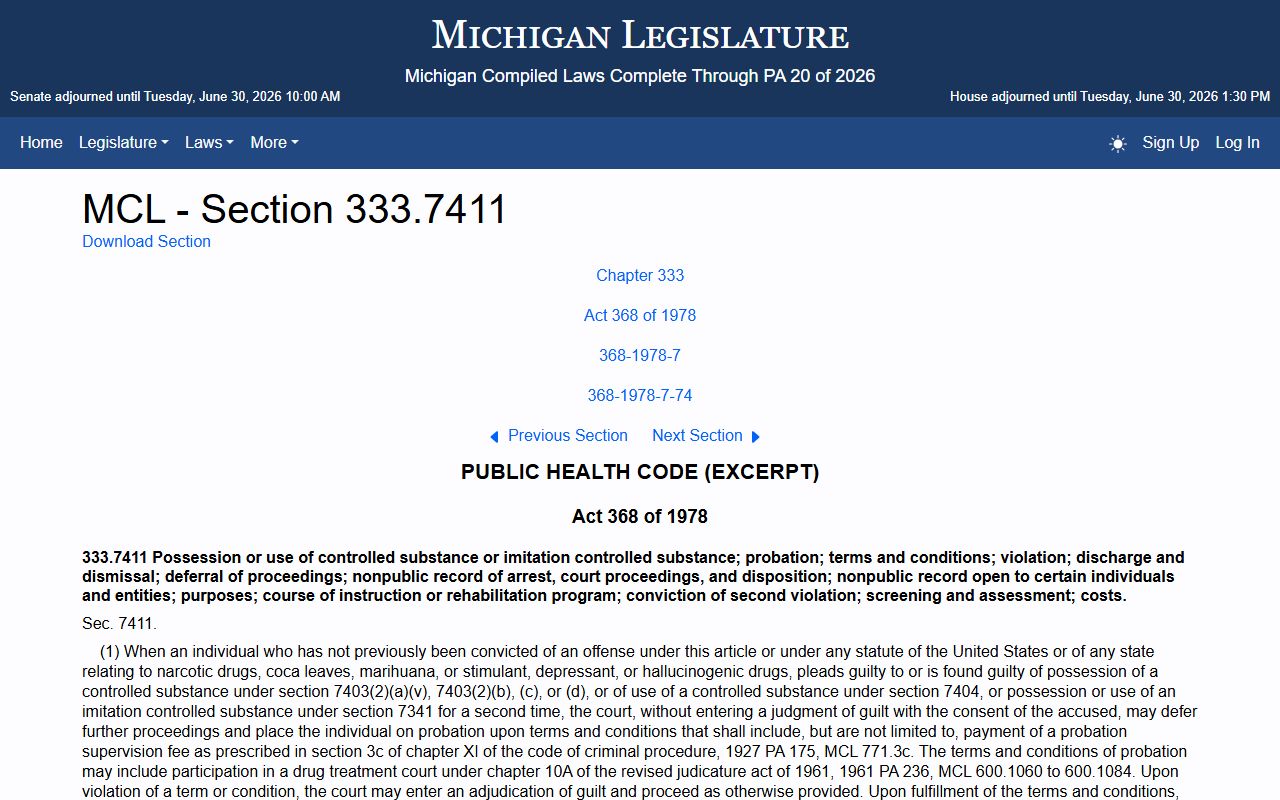
Deferral is why a charge can appear serious at filing yet resolve with no conviction on the record, which changes how the case should be read.
Charge Codes and Severity Levels in Clare County
Every Clare County charge is tied to a Michigan statute and coded to it. That code fixes the offense and its severity, which is what separates a felony from a misdemeanor. Felonies carry the heaviest exposure and route to the 55th Circuit Court in Harrison. Lower misdemeanors and civil infractions stay in the 80th District Court.
One Clare County arrest can produce several separate charges. A single incident might generate a felony count, a companion misdemeanor, and a traffic infraction, each with its own code and its own status. Reading the charge list means reading each line on its own, because they can resolve in different ways. A dismissed misdemeanor sitting next to a pending felony is common, and the two do not rise or fall together.
Charges vs. Convictions
Being charged is not the same as being convicted. A charge is an accusation the prosecutor believes it can prove. A conviction is the result once a defendant pleads or a court finds guilt. Both appear in the public record, so a search can show a charge that never became a conviction.
| Charge | Conviction | |
|---|---|---|
| Stage | Accusation | Verdict or plea |
| Burden of Proof | Probable cause | Beyond reasonable doubt |
| Public Record | Yes | Yes |
This is why a Clare County arrest record or a charge alone should never be read as proof of guilt. Many charges are reduced, dismissed, or resolved without a conviction ever being entered.
Clearing a Clare County Charge After Dismissal
A dismissed Clare County charge does not always vanish from every system on its own. Michigan gives several routes to clear or hide a record, and the right one depends on how the case ended. When a charge is dismissed, some Clare County arrest records can be removed from the state criminal-history file under a specific statute.
For Clare County convictions, Michigan uses a set-aside process rather than a courtroom-style seal. An application-based set-aside has waiting periods measured from sentencing or completion. The felony and serious-misdemeanor timing lives in the set-aside waiting-period statute (MCL 780.621d).
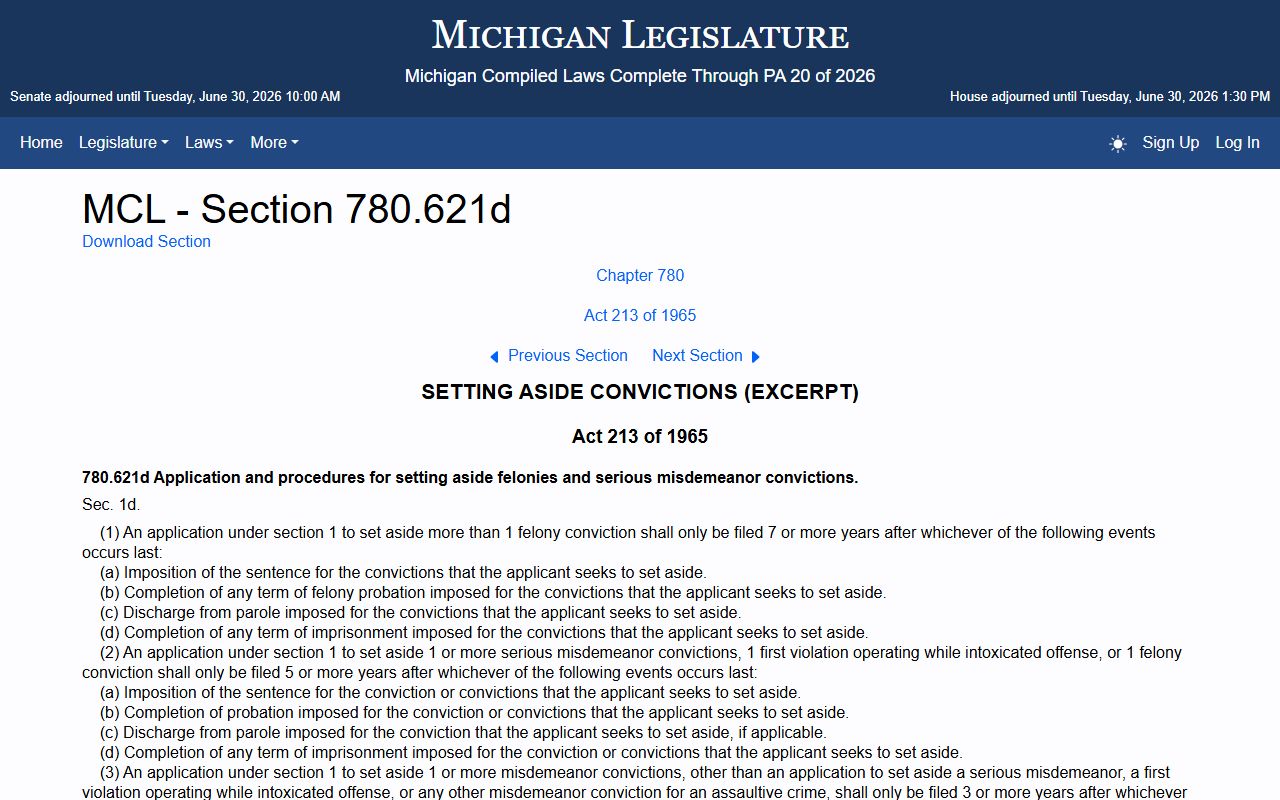
Those waiting periods decide when a person can even apply, so they are the first thing to check before starting a set-aside.
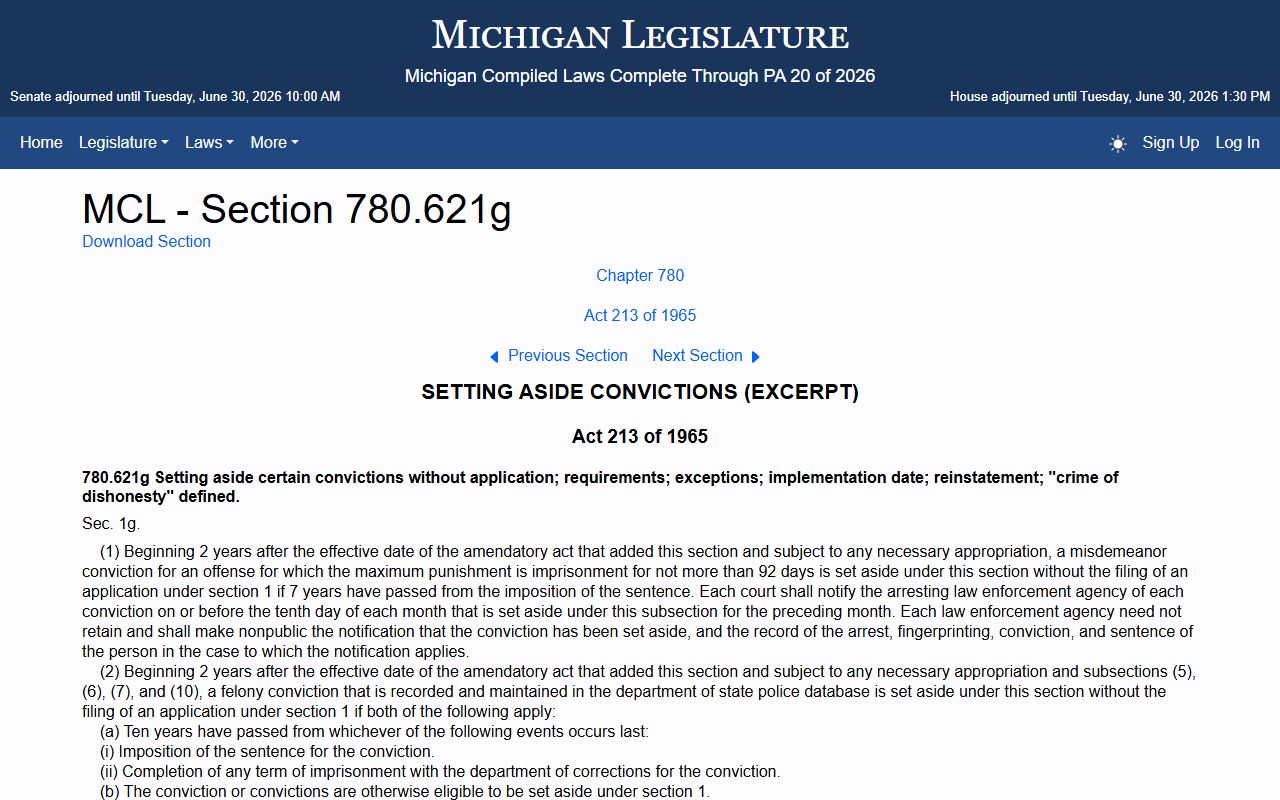
Michigan also added an automatic Clean Slate track. Eligible convictions can be set aside without an application once the waiting period passes and no active case is pending. The rules sit in the automatic set-aside statute (MCL 780.621g).
Automatic relief still stalls if a case is open, so a pending charge anywhere can block the set-aside a person expects.
Statewide Charge and Criminal History Lookups
Clare County charges roll up into the statewide criminal history maintained by the Michigan State Police. The name-based tool is the Internet Criminal History Access Tool (ICHAT). It runs a fee-based search by name or, on the fingerprint path, by print submission.
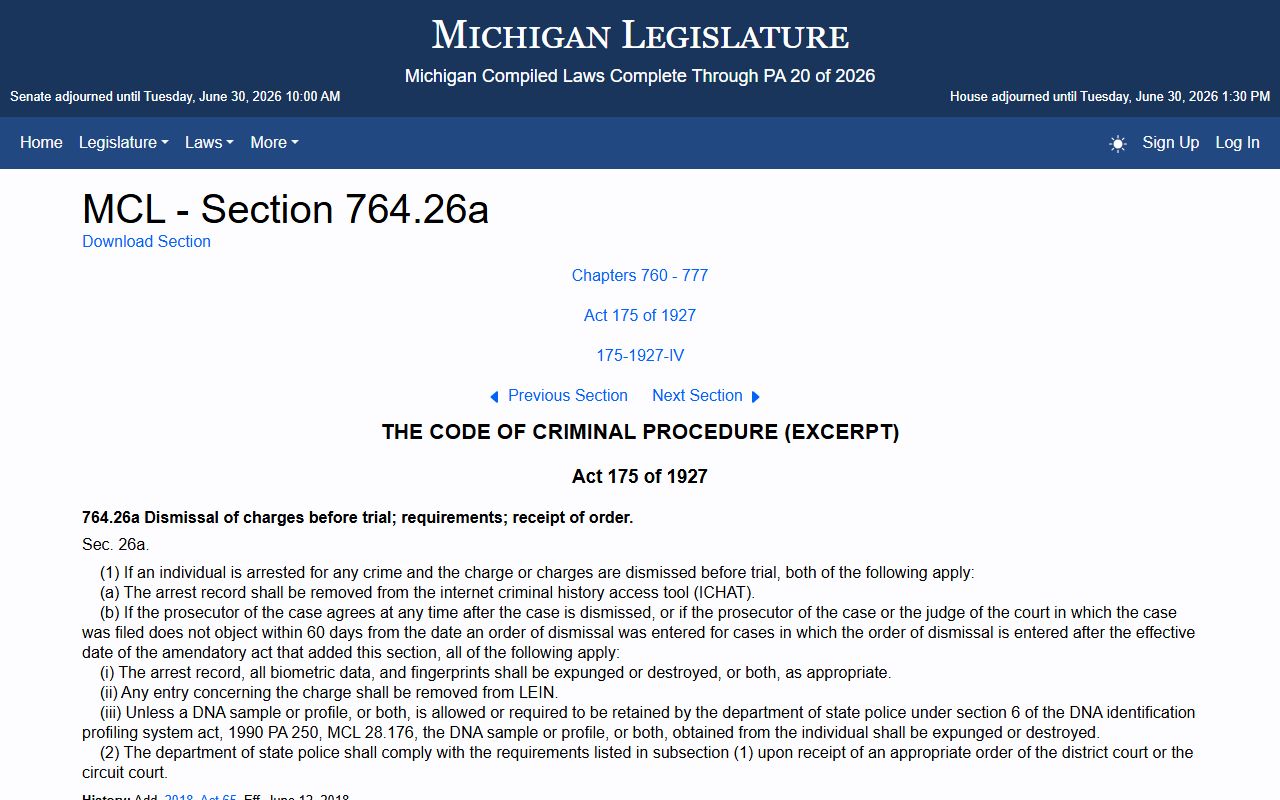
ICHAT has real limits. It does not show warrants, juvenile records, traffic records, or local ordinance misdemeanors, and it does not carry out-of-state matters. Some dismissed arrest records can be removed from that file under the state's arrest-record removal rule. The exact language is in the arrest-record removal statute (MCL 764.26a).
Background Check Considerations
A casual Clare County name search is not the same as a regulated background check. Employment, tenant, and credit screening fall under the federal Fair Credit Reporting Act, which sets accuracy and dispute rules a casual lookup does not. For those uses, a licensed screening company that follows FCRA procedures is the correct source, not a public case search.
Important: This site is not an FCRA-regulated consumer reporting agency, and its records may not be used for employment, tenant, credit, or insurance decisions.
Restricted Charge Records in Clare County
Not every Clare County charge is open to the public. Juvenile charges are generally sealed and reachable only by court order. Set-aside convictions drop out of normal public search, and files with a sealing order stay out of view. Personal identifiers such as Social Security and financial account numbers are redacted or treated as nonpublic under Michigan court rules.
Dismissed Clare County charges can also be pulled from the state criminal-history file. That removal runs through the same arrest-record rule that governs the statewide record. The full authority is set out in the arrest-record removal statute.
Because a case can be public in the court file yet removed from the state history, a reader may see two different answers depending on which system they check.